

It starts with a familiar scene in many STEM classrooms.
A drone takes off, and the room changes almost instantly. Students look up. Some follow its path with their eyes. Some try to guess where it will move next. Others begin to wonder why it can stay balanced, how it responds to control, and what is happening behind that smooth movement.
This is what makes drone-based learning so powerful. It gives students something they can see, control, test, and question right away.
But the real value of drone learning begins when that first moment of excitement becomes a path for deeper exploration. Students are not only flying a device. They are starting to connect movement with code, sensors, structures, visual feedback, and intelligent system behavior.
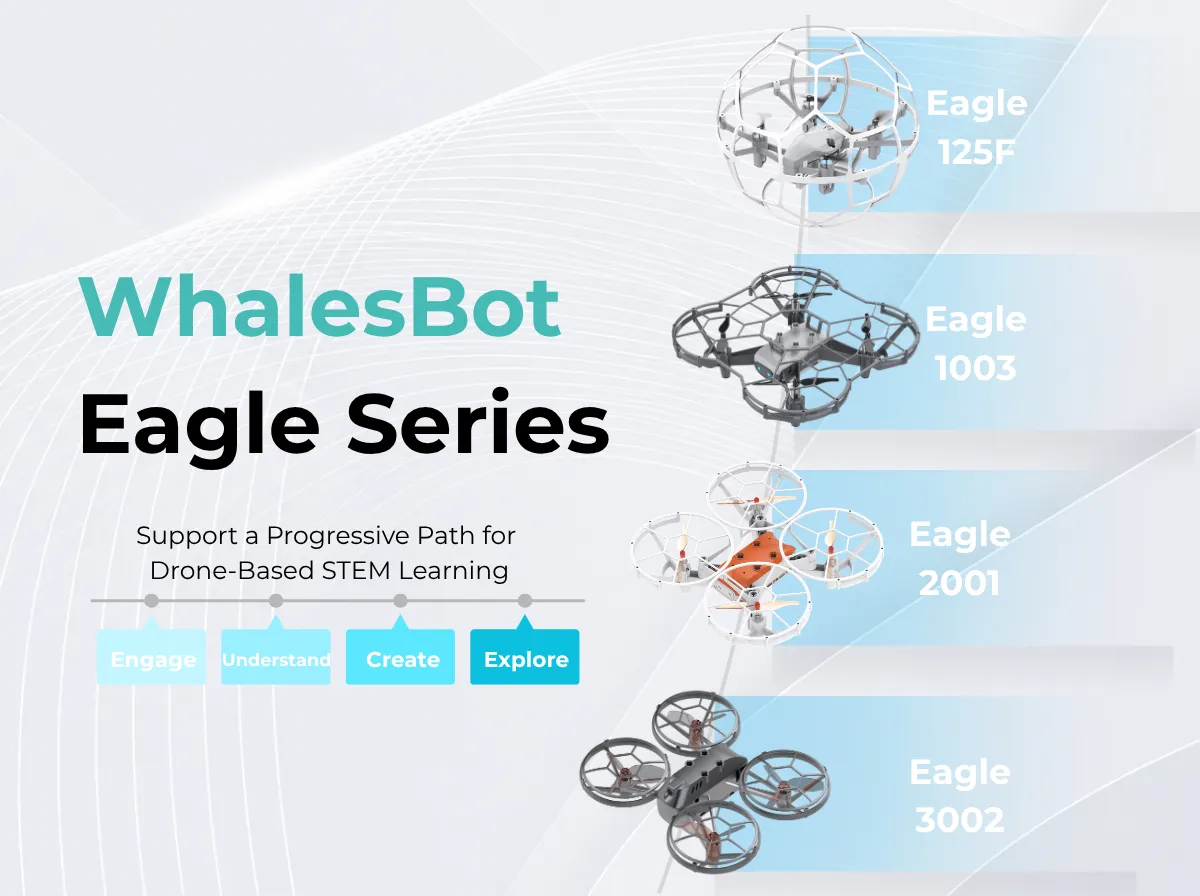
That is the progression behind the WhalesBot Eagle series. Designed as a structured drone learning pathway, the series helps students move from active first flights to programming, building, AI vision, and more advanced STEM exploration.
Stage 1: Engage
Every learning journey needs an entry point that feels simple, accessible, and inviting.
For many students, drone-based STEM learning does not need to start with complex code or flight theory. It can start with something much more immediate: movement, direction, focus, teamwork, and the confidence to take control. When students are physically involved in the activity, technology stops being something they only watch. It becomes something they can experience, respond to, and learn from.
This is where Eagle125F creates a strong first step.
Designed as a game-based drone for active classrooms, Eagle125F turns first flight into a safe, playful, and highly interactive learning experience. Through drone football, students can practice spatial recognition, hand-eye coordination, focus, timing, and teamwork while feeling the excitement of real drone movement.
Eagle125F helps make this first stage easier to enter through:
· Game-based flight: Drone football turns movement, timing, and coordination into an active part of the learning process.
· Safe enclosed design: The fully protected frame helps reduce risk during indoor flight, giving students more confidence to practice, compete, and try again.
· Ready-to-fly setup: No programming or assembly is required, so educators can bring drone activities into classrooms, gyms, or learning spaces with less preparation.
· Indoor-friendly format: Its compact, lightweight design supports indoor drone activities without the need for a large outdoor space.
Stage 2: Understand
Once students become comfortable with flight, their curiosity often moves from control to understanding.
A drone does not move simply because someone presses a button. Behind every turn, hover, and response, there is control logic, sensor feedback, and a connection between digital instructions and physical movement. At this stage, students begin to see flight as something they can not only operate, but also interpret, program, and improve.
Eagle1003 supports this deeper stage of drone-based STEM learning. As a programmable drone built for real-world learning, it connects flight with AI vision, coding, sensors, and remote control, helping students understand how drones sense, respond, and turn code into visible action.
With Eagle1003, students can explore:
· Programmable control: Support for block-based coding, Python, and C helps students move from basic logic to more advanced control, making programming progression more visible and practical.
· AI vision module: Students can explore how drones recognize visual information and use it for positioning, recognition, and task-based responses.
· 20-plus sensors and actuators: Add-on modules such as flame sensors and obstacle detection give students more ways to test inputs, outputs, and real-world behaviors.
· Stable flight system: Optical flow, gyroscope, barometer, and laser modules help keep flights smooth and accurate, creating a more reliable environment for coding practice, testing, and repeated adjustment.
Stage 3: Create
Understanding a system is one thing. Rebuilding it is another.
In STEM learning, building gives students a different kind of insight. It helps them see that every machine is shaped by design choices: how parts are connected, how weight is balanced, how movement is generated, and how one structure can be transformed into another.
This is where Eagle2001 brings drone learning into creative engineering.
As a modular flying machine, Eagle2001 allows students to disassemble, rebuild, transform, and test different robotic forms. A drone can become a vehicle, a boat, a walking machine, or another structure students imagine. Through this process, ideas are not only discussed. They are built, tested, adjusted, and turned into working prototypes.
Eagle2001 opens up several hands-on learning possibilities:
· Modular transformation: Students can rebuild Eagle2001 into drones, vehicles, boats, walking machines, and more, exploring how different structures create different types of movement.
· Cross-kit compatibility: It works with other WhalesBot structural parts, sensors, and expansion modules, giving students more room for open-ended creation and extended projects.
· Learning through building: Students explore engineering, mechanics, flight principles, and structural design through hands-on experimentation.
· From idea to prototype: Eagle2001 encourages creative problem-solving by helping students build, test, adjust, and improve real functional machines.
Stage 4: Explore
By the final stage, the drone is no longer just a machine in the air. It becomes a platform for exploring intelligent systems.
At this level, students begin to connect vision, sensors, programming, motion, and feedback into more advanced STEM projects. The focus moves beyond “How can I control the drone?” and toward a deeper question: “How can the drone see, respond, follow, and complete tasks more intelligently?”
Eagle3002 is designed for this stage of advanced exploration.
As a programmable FPV AI drone, it brings together real-time vision, programmable flight, multi-sensor control, expandable ports, and brushless motors. This gives students a more complete platform for testing how intelligent systems sense the environment, process information, and respond through movement.
Eagle3002 supports this advanced stage through:
· Real-time FPV view: Students can see what the drone sees, helping them understand flight, space, and direction from the drone’s perspective.
· Programmable flight: Students can code routes, trigger actions, and observe how digital instructions become real movement in the air.
· Multi-sensor system: Sensors help the drone sense, react, and follow, giving students a clearer view of how intelligent systems respond to changing environments.
· Expandable ports: Additional sensors and modules can be added, allowing students to extend functions and build more advanced project scenarios.
· Brushless motors: Smoother, more stable flight gives students a more reliable environment for testing, adjusting, and repeating experiments.
Together, these capabilities help students move from basic flight experience to intelligent systems exploration, where coding, sensing, feedback, and motion become part of one connected learning process.
Conclusion
Drone-based STEM learning becomes more meaningful when it is designed as a progression, not a one-time activity.
With the Eagle series, students can start with safe movement and active play, then move into coding, sensing, modular building, AI vision, and intelligent flight projects. Each stage adds a new layer of understanding, helping learners move from “I can fly it” to “I can understand how it works, rebuild it, and explore what it can do next.”
For educators, this creates more than a product sequence. It offers a practical learning pathway that can support broader goals in STEM education, computational thinking, and AI literacy, while helping students build confidence, technical thinking, creativity, and systems understanding through hands-on drone exploration.
From first flight to intelligent systems, the goal is not only to teach students how to use drones. It is to help them understand how technology moves, responds, and can be shaped by their own ideas.
Looking to build a progressive drone learning pathway for your school or program?
Explore the WhalesBot Eagle drone series and see how each model supports a different stage of STEM learning: https://www.whalesbot.ai/products/drone

.png)