



Artificial intelligence is changing how students learn, create, and interact with technology. But understanding AI goes beyond writing code or training models. What if students could see AI recognize objects, make decisions, and turn digital instructions into physical actions?
That's where Physical AI educational robots come in.
By combining AI capabilities with robotics, these learning tools make intelligent systems more tangible and interactive. Students can explore how AI works, experiment with their own ideas, and discover how technology responds to the world around them.
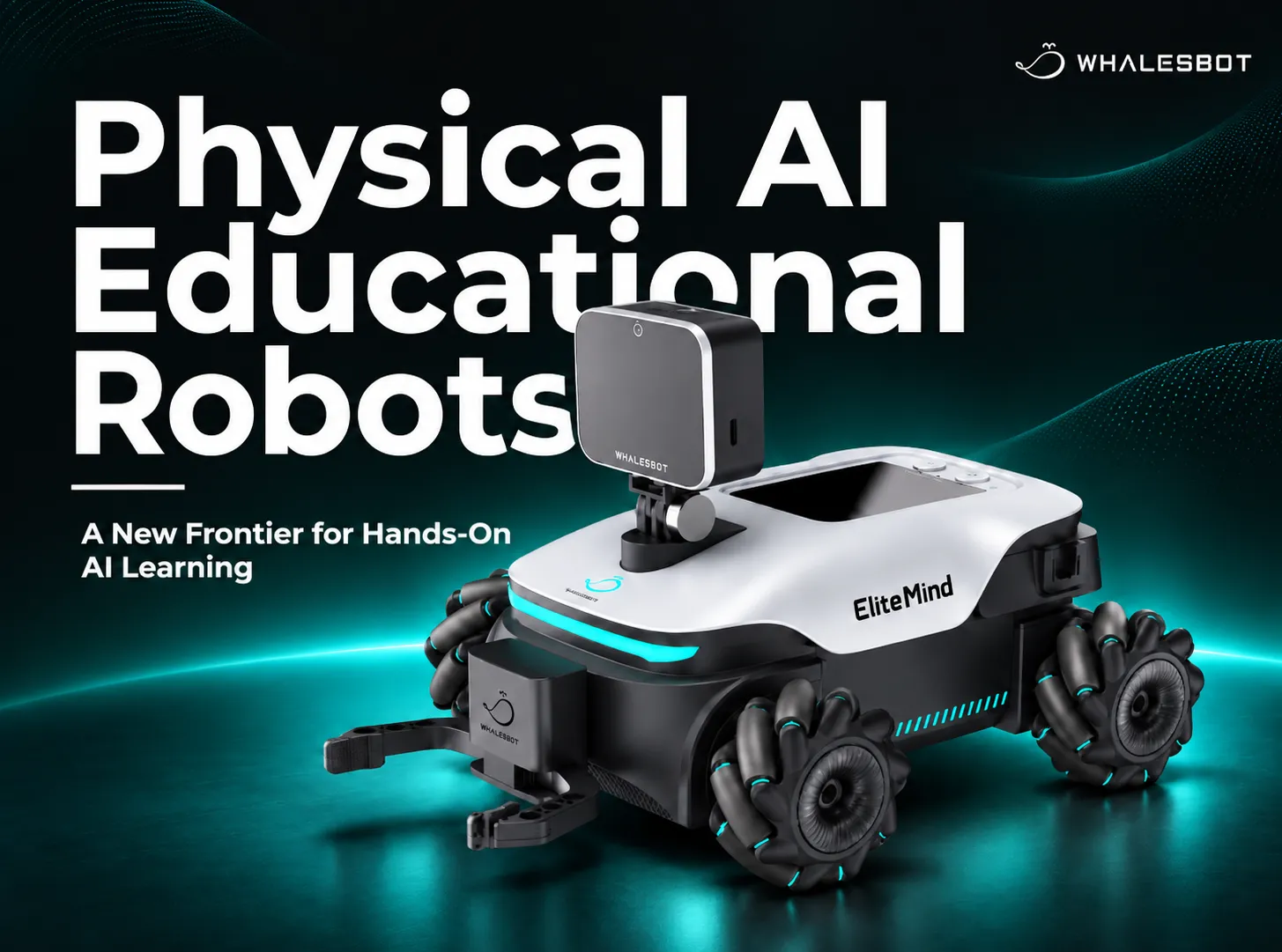
In September 2026, WhalesBot introduced EliteMind, a modular Physical AI educational robot designed to connect digital AI learning with real-world practice. EliteMind will be showcased at the WhalesBot 2027 Global Product Launch Event on December 4, 2026.
What Are Physical AI Educational Robots?
Physical AI educational robots help students explore how intelligent systems perceive their surroundings, process information, make decisions, and perform physical actions.
Unlike traditional robots that primarily follow predefined instructions, these robots can integrate AI models, sensors, and physical control to support more intelligent interactions.
For students, this means moving beyond observing results on a screen. They can program a robot to recognize an object, respond to instructions, or complete a task, then observe what happens in the real world.
Through testing and refining their ideas, students gain a deeper understanding of AI while developing creativity, problem-solving skills, and AI literacy.
From Advanced Robotics to Early AI Literacy
In recent years, AI has become an increasingly important part of hands-on education. In 2023, several products demonstrated how AI capabilities could be integrated into robotics education and research:
• UBTECH UGOT: Combined AI vision and programming with modular robot building, allowing students to explore AI through hands-on construction.
• Unitree Go2 EDU: Supported advanced education and research in AI-driven motion control, environmental perception, and autonomous navigation.
As AI becomes more deeply embedded in everyday life, greater emphasis is being placed on developing AI literacy from an early age. More recent educational robots reflect this growing focus:
• 2025 | VEX AIM: Combined AI vision with robot programming, allowing students to explore how intelligent systems perceive their surroundings and make decisions.
• 2026 | FF Nova Mini: Paired a programmable humanoid robot with introductory Physical AI courses, connecting AI concepts with hands-on practice.
Together, these developments reflect the expanding role of AI in hands-on education, from advanced robotics research to helping younger students build a foundational understanding of intelligent systems.
WhalesBot EliteMind: From AI Concepts to Real-World Practice
As Physical AI educational robots become more capable, the next challenge is making these technologies accessible and meaningful for students.
For WhalesBot, the answer lies in a connected AI learning journey that brings together OceanLevel, W-Hong LLM, and EliteMind.
Explore and Create with OceanLevel
Through WhalesBot's AI & STEM learning platform, students explore AI concepts, understand how intelligent systems work, and develop their own AI models and programs.
Connect Intelligence with W-Hong LLM
W-Hong LLM provides the intelligence behind EliteMind, supporting perception, reasoning, interaction, and AI-driven creation. Combined with the robot's sensing and control capabilities, it helps turn AI-powered decisions into real-world responses.
Experiment and Refine with EliteMind
Students can bring their digital creations into the physical world, testing programs, observing robot behaviors, and refining their ideas through hands-on experimentation.
Together, these connected experiences help students move from understanding AI to creating with it, making abstract concepts something they can see, interact with, and explore.
Beyond the Classroom: Learning Through Real-World Challenges
Hands-on AI learning doesn't have to end when the class is over.
Through ENJOY AI international robotics competitions, WhalesBot offers young people further opportunities to apply their knowledge, collaborate with others, and take on new challenges.
From classroom exploration to robotics competitions, students can continue developing their skills, testing creative ideas, and discovering new possibilities with AI.
Bringing Physical AI Learning to More Young People
As AI becomes increasingly part of everyday life, helping young people develop AI literacy is more important than ever.
“We believe every young person should have the chance to understand AI, explore their own ideas, and learn to work alongside AI to build a better world,” said Xufeng Fei, CEO of WhalesBot.
Working with educators and partners worldwide, WhalesBot aims to make hands-on Physical AI learning accessible to more young people, empowering them to explore technology and turn their ideas into real-world creations.
Want to see Physical AI educational robots in action?
EliteMind will take the spotlight at the WhalesBot 2027 Global Product Launch Event on December 4, 2026.
Join us live online to get a closer look at EliteMind and discover what's next for WhalesBot in AI & STEM education. Click here to register for the event!


